

Surose
Surose Karki is an SEO specialist with over five years of experience in optimizing websites for search engines and driving organic growth. He specializes in on-page SEO, local SEO, and content strategy, with a strong focus on improving search visibility, user experience, and conversion performance. With a data-driven approach and deep understanding of search intent, Surose helps businesses build sustainable digital presence through strategic optimization, technical precision, and high-quality content execution.
In an increasingly competitive digital landscape, simply “doing SEO” isn’t enough. Success in organic search today demands more than a handful of blog posts, a few backlinks, or technical tweaks. You need a clear, structured, and data-driven SEO strategy, one that aligns with your business goals, serves your target audience, and adapts to how search engines evolve.
An effective SEO strategy is a structured, goal-oriented plan that guides how a website improves its visibility in search engine result pages (SERPs). Unlike one-off tactics, a strategy aligns business objectives with search intent, targeting the right audience through optimised content, technical infrastructure, and performance tracking. This approach ensures consistent growth in organic traffic and improved rankings over time.
This guide covers the complete SEO planning process for 2025 and beyond. It includes setting business-aligned goals, performing keyword research, mapping keywords to content, building a content calendar, optimising technical SEO, applying E-E-A-T principles, and measuring results using performance data. Each section offers practical steps for marketers, SEO teams, or businesses looking to build a scalable, data-backed SEO strategy that adapts to algorithm changes and evolving search behavior.
Why You Need an SEO Strategy (and Not Just Random SEO Tactics)
Many businesses fall into the trap of treating SEO as a collection of isolated actions, publishing blog posts occasionally, stuffing pages with keywords, or fixing technical issues only when rankings drop. These random SEO tactics might deliver short-term visibility, but they rarely lead to meaningful, long-term results.
An SEO strategy, on the other hand, is a structured, long-term plan that aligns with your business objectives. It connects every action, from keyword research and content creation to technical optimization and link building, to a unified goal: sustainable growth in organic search performance.
✅ Strategy vs. Tactics: What’s the Difference?
- Tactics are the individual activities you perform: optimising a title tag, fixing a broken link, writing a blog post.
- Strategy defines why you’re doing those things, when you do them, and how they support broader business goals like increasing qualified leads or growing market share.
Without a strategy, SEO efforts become reactive and inefficient. You might target the wrong keywords, create redundant content, or miss critical technical issues that limit visibility on search engine result pages (SERPs).
A data-driven, scalable SEO strategy gives you:
- A clear roadmap for content and technical improvements
- Better alignment with your target audience’s intent
- More effective resource allocation
- The ability to track and measure SEO success over time
Most importantly, a solid strategy allows you to adapt, whether you’re responding to Google algorithm changes, shifts in search behavior, or new business priorities. As search engines become more intelligent and competitive landscapes intensify, strategic SEO planning isn’t optional, it’s essential.
Step 1: Define Your Goals and Understand Your Audience
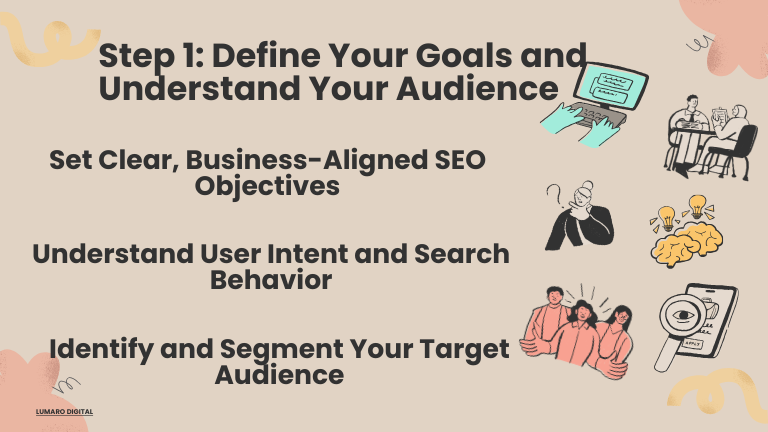
Every effective SEO strategy starts with a clear understanding of what you’re trying to achieve, and who you’re trying to reach. Without defining business-aligned goals and deeply understanding your audience, SEO becomes guesswork. This foundational step ensures that your efforts generate measurable impact by attracting the right traffic, at the right time, for the right reasons.
Set Clear, Business-Aligned SEO Objectives
SEO doesn’t exist in a vacuum, it should directly support your business goals. Whether you’re aiming to generate leads, increase online sales, build brand authority, or reduce customer acquisition costs, your SEO objectives should reflect these outcomes.
Start by defining Key Performance Indicators (KPIs) such as:
- Organic traffic growth in target segments
- Ranking improvements for high-value keywords
- Increase in conversions from organic sessions
- Reduced bounce rates or improved dwell time on key pages
These KPIs should be SMART: Specific, Measurable, Achievable, Relevant, and Time-bound. For example, “Increase organic traffic to product category pages by 25% over the next quarter” is a clear, actionable goal.
Align these SEO goals with stakeholders across marketing, product, and sales to ensure you’re not optimizing in isolation, but contributing to broader strategic objectives.
Understand User Intent and Search Behavior
Modern SEO is about understanding why people search, not just what they type into Google. Each keyword represents a user intent — informational, navigational, transactional, or commercial investigation.
To decode user intent:
- Analyze search queries using tools like Google Search Console and keyword research platforms.
- Study the SERP features (e.g., featured snippets, shopping results, local packs) that appear for target keywords.
- Assess competitor pages that are ranking — what content types and formats are dominating?
For instance, a query like “best SEO tools for startups” signals a need for comparison-based content, while “buy SEO tool subscription” indicates transactional intent. Your content and landing pages must align with this behavior to be visible, and useful, to users.
Identify and Segment Your Target Audience
Not all traffic is equal. Effective SEO focuses on attracting qualified visitors — people most likely to convert, engage, or return. That requires clearly identifying and segmenting your target audience based on intent, interests, and stage in the buyer journey.
Start with building or refining buyer personas:
- What are their goals, pain points, and search behaviors?
- What kind of content do they consume?
- What devices or platforms do they use?
Use demographic data, on-site behavior, and even CRM insights to create audience segments.
For example:
- First-time vs. returning users
- B2B decision-makers vs. practitioners
- Local vs. international searchers
These insights help you personalise content, choose the right keywords, and prioritize pages that serve specific audience groups, ensuring your SEO strategy is user-first and market-relevant.
Step 2: Perform Keyword Research and Build a Keyword Strategy
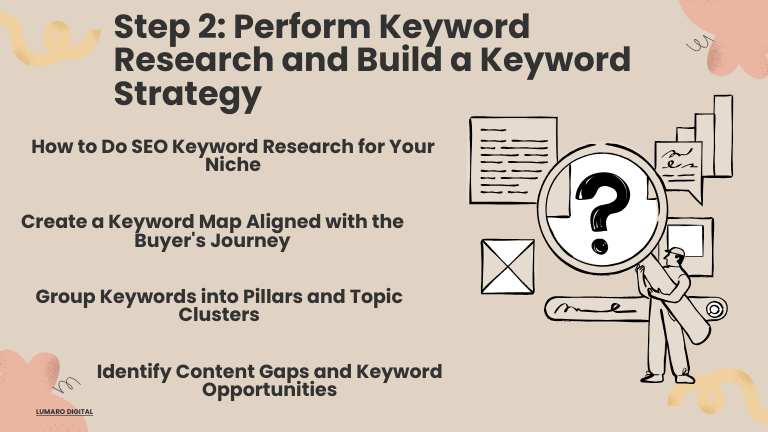
A successful SEO strategy is built on the foundation of relevant, high-impact keywords that match your audience’s intent. Keyword research isn’t just about finding what people search for it’s about understanding how those searches align with your business goals and how you can create content that answers them better than your competitors.
This step involves discovering valuable keywords, organizing them into a strategic structure, and identifying content opportunities to build topical authority and drive consistent organic traffic.
How to Do SEO Keyword Research for Your Niche
Effective keyword research begins with understanding your niche, the specific problems, language, and behaviors of your target audience. Here’s how to start:
Use Keyword Tools:
Leverage platforms like Google Keyword Planner, Ahrefs, SEMrush, or Ubersuggest to find keywords based on seed terms, competitor URLs, or related questions.
Analyze Search Volume & Difficulty:
Look for keywords with a balance of search volume and competitiveness. High-volume terms are great, but mid- and long-tail keywords often convert better and are easier to rank for.
Look at SERPs and Competitors:
Study what already ranks for your target queries. What kind of content is being rewarded? What gaps can you fill?
Explore Related Queries and ‘People Also Ask’:
These often surface additional questions and subtopics that indicate semantic intent, perfect for building comprehensive content.
Use these techniques not just to create a keyword list, but to understand the language and pain points of your market.
Create a Keyword Map Aligned with the Buyer's Journey
Once you have your keyword list, the next step is to map keywords to the user journey — from awareness to consideration to decision.
- Top of Funnel (TOFU): Informational queries like “what is SEO strategy” or “how to increase website traffic”
- Middle of Funnel (MOFU): Comparison queries like “best SEO tools for small businesses” or “SEO vs. PPC”
- Bottom of Funnel (BOFU): Transactional queries like “SEO agency near me” or “buy SEO course online”
Align each keyword to:
- Page types (blog posts, product pages, landing pages, etc.)
- Content formats (how-to guides, checklists, videos, etc.)
- Conversion goals (newsletter signup, lead generation, purchase, etc.)
This ensures your content serves users at every stage, increasing visibility and conversions throughout the funnel.
Group Keywords into Pillars and Topic Clusters
Search engines increasingly reward topical authority, websites that cover a subject in depth. To achieve this, organize your keywords into pillar pages and supporting content clusters.
- Pillar Pages: Broad, comprehensive guides targeting core topics (e.g., “Complete Guide to SEO Strategy”)
- Cluster Pages: Narrower, supporting articles that target specific subtopics (e.g., “Technical SEO Checklist” or “How to Do Keyword Research”)
Interlink these pages using contextual internal links to help users (and search engines) navigate the topic hierarchy. This not only improves SEO but also strengthens site architecture and user experience.
Identify Content Gaps and Keyword Opportunities
Finally, assess your existing content and your competitors’ to spot gaps — areas where user demand exists but your content is missing or underperforming.
Use tools like:
- Ahrefs’ Content Gap Analysis
- SEMrush’s Keyword Gap Tool
- Google Search Console (to identify queries you’re showing up for but not ranking well)
Look for:
- Keywords with traffic potential that your site doesn’t target
- Competitor pages ranking for terms you haven’t covered
- High-impression, low-CTR queries (a sign your page needs better optimization)
Filling these gaps helps you capture untapped traffic, expand topical depth, and improve overall search engine visibility. This is where smart, strategic SEO planning outperforms tactical guesswork.
Step 3: Build a Strategic SEO Content Plan
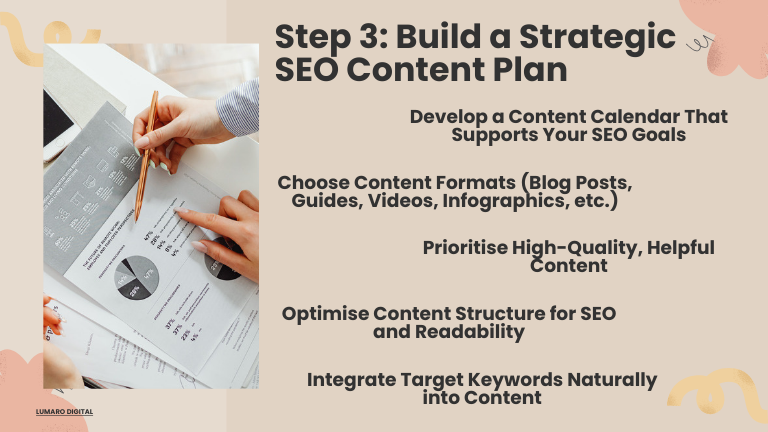
With your keyword strategy in place, the next step is to turn it into content — strategically planned, high-quality, and optimized for both users and search engines. A content plan is more than a publishing schedule; it’s a scalable system that ensures consistency, relevance, and long-term SEO value.
This part of the strategy focuses on planning what to create, when to publish it, and how to structure it for maximum organic visibility and engagement.
Develop a Content Calendar That Supports Your SEO Goals
A content calendar is essential for maintaining momentum and ensuring your content aligns with your overall SEO objectives. Rather than publishing content reactively, a calendar allows you to plan strategically around:
- Keyword clusters and buyer journey stages
- Product launches, seasonal trends, and marketing campaigns
- Content types and internal linking opportunities
Use tools like Trello, Notion, Asana, or even Google Sheets to schedule:
- Titles and keywords
- Target personas and funnel stages
- Draft deadlines and publish dates
- Assigned writers and reviewers
An editorial calendar ensures content consistency — one of the most underrated SEO success factors.
Choose Content Formats (Blog Posts, Guides, Videos, Infographics, etc.)
Different formats serve different search intents and audience preferences. A strategic content plan should include a mix of content types to maximize reach and engagement:
- Blog Posts – Great for targeting informational keywords and building topical depth
- Long-form Guides – Ideal for pillar content and earning backlinks
- Videos – Useful for product demos, tutorials, or audience engagement (YouTube is also a search engine!)
- Infographics – Shareable content that supports link building and visual storytelling
- Case Studies / Whitepapers – Perfect for bottom-of-funnel and B2B SEO
Choosing the right format based on the keyword’s SERP intent gives your content a better chance to rank and resonate.
Prioritise High-Quality, Helpful Content
In 2025 and beyond, Google’s focus on Helpful Content and E-E-A-T means that content must be:
- Written by (or attributed to) subject matter experts
- Based on genuine insights, experience, or original data
- Designed to solve a problem or satisfy search intent
Avoid thin, keyword-stuffed content. Instead:
- Answer user questions directly and thoroughly
- Include examples, stats, or visuals to support your points
- Structure content to make it scannable and actionable
Remember, high-quality content doesn’t just rank — it earns backlinks, shares, and conversions.
Optimise Content Structure for SEO and Readability
Search engines and users both prefer content that’s well-structured. Here’s how to optimize your on-page elements:
- Use clear heading hierarchies (H1, H2, H3) to signal content sections
- Break up text with bullet points, subheadings, images, and callouts
- Add internal links to related content and supporting resources
- Optimize meta descriptions and title tags to increase CTR
Good structure improves crawlability, dwell time, and engagement, which indirectly boosts rankings.
Integrate Target Keywords Naturally into Content
Keyword integration is still critical, but forced repetition can hurt readability and user trust.
Here’s how to do it right:
- Place your primary keyword in the title, URL, first paragraph, and a subheading
- Use semantic variations and LSI (Latent Semantic Indexing) terms throughout
- Ensure your keywords support the overall topic, not just search engine bots
Always write for humans first, then refine for SEO. When done well, keyword integration strengthens relevance without compromising quality — a hallmark of effective SEO content.
Step 4: Technical SEO & Site Structure
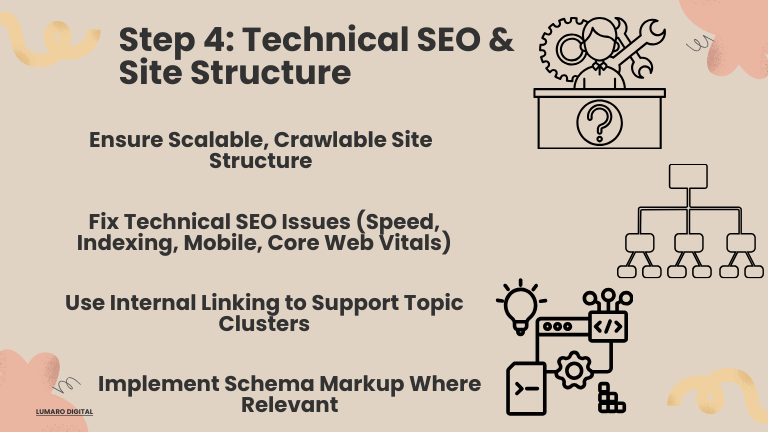
Even the best content can fail to rank if your website has technical issues that block search engines or frustrate users. A strong technical SEO foundation ensures that your site is crawlable, fast, and structured in a way that both users and search engines can easily understand.
This step is about building the architecture and infrastructure that supports long-term SEO performance, from page speed and mobile optimization to internal linking and structured data.
Ensure Scalable, Crawlable Site Structure
Your site’s architecture determines how easily search engines can discover and index your content. A scalable, crawl-friendly structure should:
- Use a clear hierarchy: Homepage → Categories → Subcategories → Pages
- Limit the number of clicks to important content (ideally ≤3 clicks from the homepage)
- Avoid orphan pages (pages with no internal links pointing to them)
- Use clean, SEO-friendly URLs that reflect the content structure
An intuitive structure benefits not just bots, but also users — helping them find what they need quickly and efficiently. Tools like Screaming Frog or Sitebulb can help you audit and optimize crawlability.
Fix Technical SEO Issues (Speed, Indexing, Mobile, Core Web Vitals)
Search engines consider technical performance signals when ranking pages. Neglecting them can seriously limit your visibility. Focus on:
- Page Speed: Use tools like Google PageSpeed Insights or Lighthouse to optimize load times. Compress images, leverage caching, and reduce render-blocking resources.
- Mobile Optimization: Ensure your site is fully responsive, touch-friendly, and easy to navigate on smaller screens.
- Indexing: Use Google Search Console to identify indexation issues, blocked pages, or duplicate content problems.
- Core Web Vitals: Optimize for Largest Contentful Paint (LCP), First Input Delay (FID), and Cumulative Layout Shift (CLS) — all critical to both UX and rankings.
Addressing these issues not only improves SEO but also directly enhances user experience, leading to better engagement and conversions.
Use Internal Linking to Support Topic Clusters
Internal links are one of the most underrated SEO assets. They:
- Help distribute authority across your site
- Guide both users and search engines to related content
- Support your pillar and cluster strategy
Best practices for internal linking:
- Use descriptive anchor text that reflects the target page’s topic
- Link from high-authority pages to newer or lower-performing pages
- Keep links relevant and helpful — avoid excessive linking for the sake of SEO
Consistent internal linking reinforces topical relationships, signaling to Google that your site is an authoritative resource on a given subject.
Implement Schema Markup Where Relevant
Schema markup (structured data) helps search engines understand the meaning of your content, not just the words. It can also enhance your listings with rich snippets, increasing your click-through rate (CTR) in SERPs.
Popular schema types include:
- Article, FAQ, How-To – for blog content
- Product, Review, Offer – for e-commerce
- Organization, LocalBusiness – for branding and local SEO
- Breadcrumb, Sitelinks – for improved navigation
Use tools like Google’s Structured Data Markup Helper or Schema.org to implement and test schema. Adding this layer of semantic information improves how your pages are displayed — and helps you stand out on crowded search engine result pages.
Step 5: Enhance Content Experience, Trust, and Authority (E-E-A-T)
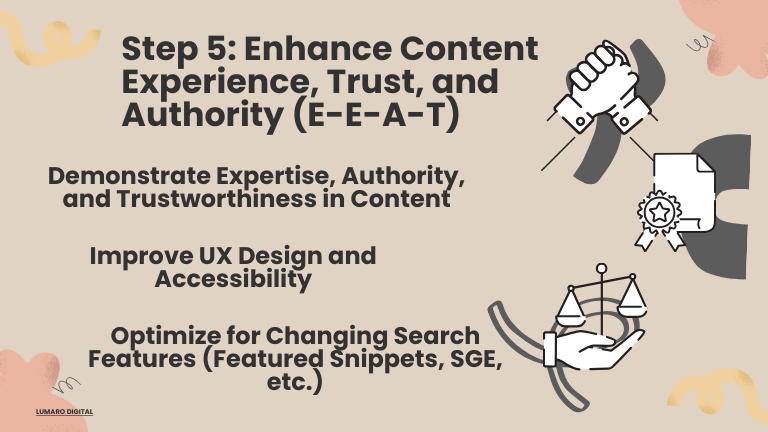
In today’s SEO landscape, content quality isn’t just about relevance or keyword targeting — it’s about credibility, trust, and user experience. Google’s Search Quality Rater Guidelines emphasize E-E-A-T: Experience, Expertise, Authoritativeness, and Trustworthiness. These signals help determine which content deserves to rank, especially in competitive or sensitive industries (YMYL: Your Money or Your Life).
This step is about creating content that not only satisfies search intent but also builds confidence with both search engines and users.
Demonstrate Expertise, Authority, and Trustworthiness in Content
To rank well and build brand loyalty, your content must prove that it comes from qualified, reliable sources. Here’s how to do that:
- Use real experts as content creators: For example, a healthcare article should be written or reviewed by a medical professional.
- Show author credentials: Include detailed author bios with links to professional profiles (LinkedIn, publications, etc.).
- Cite credible sources: Use data and references from authoritative websites (.gov, .edu, trusted publications).
- Be transparent: Disclose sponsorships, product affiliations, or biases clearly.
Adding trust-building elements like review dates, editorial policies, and about pages helps reinforce credibility. Google is increasingly capable of assessing these trust signals — and so are users.
Improve UX Design and Accessibility
A trustworthy website must also be easy to use. Poor user experience — whether from slow loading, confusing layouts, or inaccessible content — directly impacts SEO performance and engagement.
Focus on the following:
- Mobile responsiveness: Ensure layouts adjust properly across all devices.
- Accessibility: Use alt text for images, readable fonts, sufficient color contrast, and keyboard navigation support.
- Readability: Break up long paragraphs, use clear headings, and follow a logical flow.
- Page design: Avoid intrusive popups, auto-playing videos, and other disruptive elements.
Great UX design not only improves dwell time and reduces bounce rates, but also sends positive signals to search engines about your content’s value.
Optimize for Changing Search Features (Featured Snippets, SGE, etc.)
Search is no longer limited to “10 blue links.” Google now delivers content through a variety of formats:
- Featured snippets
- People Also Ask boxes
- Knowledge panels
- Google’s Search Generative Experience (SGE)
To optimize for these:
- Structure answers clearly using headings, bullet points, and concise paragraphs
- Use question-based subheadings (e.g., “What is an SEO strategy?”)
- Include definitions, lists, comparisons, and stats that are easy to extract and display
- Leverage schema markup (e.g., FAQPage, HowTo)
With the rise of AI-powered search formats, content clarity and structure are more important than ever. Optimizing for these enhanced features increases your SERP visibility, drives more traffic, and establishes your site as a go-to authority in your niche.
Step 6: Monitor, Measure, and Evolve Your SEO Strategy
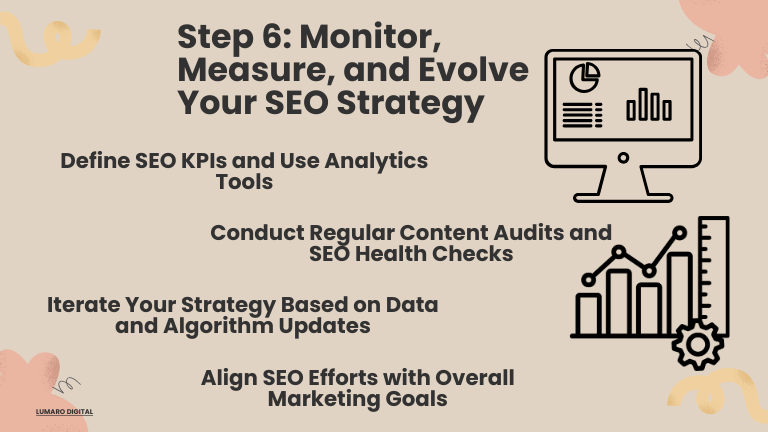
SEO is not a “set it and forget it” discipline. Even the most well-planned strategies must be monitored, refined, and adapted over time. Whether it’s a Google algorithm update, shifting user behavior, or new competitors entering your niche, change is constant in SEO.
This step is about building a data-driven feedback loop — measuring performance, identifying what works, and evolving your SEO strategy accordingly to stay competitive and aligned with your business goals.
Define SEO KPIs and Use Analytics Tools
To track the effectiveness of your SEO strategy, you need clear, measurable KPIs (Key Performance Indicators). These should align with your business objectives and could include:
- Organic traffic to priority pages
- Keyword rankings for strategic terms
- Click-through rates (CTR) from search engine result pages (SERPs)
- Conversion rates from organic sessions (leads, sales, sign-ups)
- Bounce rate and average time on page
- Pages indexed vs. total pages published
Use tools like:
- Google Search Console for indexing, impressions, clicks, and CTR
- Google Analytics 4 for user behavior and conversions
- Ahrefs / SEMrush for keyword and backlink tracking
- Looker Studio to visualize performance dashboards
These metrics allow you to quantify success, identify areas for improvement, and communicate ROI to stakeholders.
Conduct Regular Content Audits and SEO Health Checks
SEO success is cumulative, but outdated or underperforming content can drag your site down. Regular content audits ensure your content stays relevant, optimized, and aligned with user intent.
Steps for a content audit:
- Export all URLs and SEO data (traffic, rankings, engagement)
- Categorize content: keep, update, merge, or delete
- Identify thin content, outdated topics, and duplication
- Review technical elements (meta tags, internal links, structured data)
In addition, perform SEO health checks:
- Fix broken links or 404 errors
- Resolve redirect chains
- Re-submit important pages for indexing
- Check Core Web Vitals and mobile usability
These audits help maintain a healthy, high-performing site over time — essential for long-term SEO growth.
Iterate Your Strategy Based on Data and Algorithm Updates
Google rolls out thousands of updates annually, some of which significantly impact rankings. To maintain and improve performance, you must adapt your strategy proactively.
How to stay agile:
- Monitor industry news and algorithm update trackers (e.g., Moz, Search Engine Roundtable)
- Analyze traffic drops with Search Console or Analytics to pinpoint affected pages
- Refocus on E-E-A-T, helpful content, and user-first design — especially after quality updates
- Test new content formats, keywords, or internal linking strategies
Use data to guide your iterations — not guesswork. SEO is as much about learning and adjusting as it is about planning.
Align SEO Efforts with Overall Marketing Goals
Your SEO strategy shouldn’t operate in a silo. It must support and integrate with your broader marketing and business goals, including:
- Product marketing and launch campaigns
- Brand messaging and positioning
- Paid media (using SEO insights to lower CAC or inform ad copy)
- Sales enablement and lead generation
Work closely with content teams, product owners, and marketers to align messaging, keyword targeting, and performance tracking across channels.
When SEO supports the full marketing funnel, it becomes more than a traffic driver — it becomes a revenue-generating growth engine.
Step 7: SEO Strategy Example: Blog vs. E-Commerce Site
While the core principles of SEO remain consistent — understanding intent, targeting keywords, creating valuable content, and ensuring technical health — the tactics and priorities vary significantly depending on your business model.
To illustrate how an SEO strategy adapts by niche, let’s compare two real-world scenarios: a content-driven blog and a product-focused e-commerce site.
Example 1: Blog SEO Strategy
Goal: Attract organic traffic and build topical authority to monetize through ads, email lists, or affiliate links.
Key Focus Areas:
- Keyword Research: Focus on informational and long-tail queries (e.g., “how to start intermittent fasting”, “best budget travel tips for Europe”).
- Content Planning: Create a robust content calendar around topic clusters. Prioritize helpful, evergreen content with regular updates.
- E-E-A-T Optimization: Include author bios, credentials, and experience to build trust — especially for YMYL topics (e.g., health, finance).
- Internal Linking: Connect related blog posts to reinforce topical depth and distribute link equity.
- SERP Feature Targeting: Structure content for featured snippets, FAQs, and “People Also Ask” boxes using headings, lists, and schema markup.
KPIs to Track:
- Organic sessions
- Time on site and bounce rate
- Affiliate click-through rate
- Newsletter signups or lead magnets
Example 2: E-Commerce SEO Strategy
Goal: Drive high-intent traffic to product and category pages to increase conversions and revenue.
Key Focus Areas:
- Keyword Research: Target commercial and transactional keywords (e.g., “buy running shoes online”, “best DSLR cameras under $1000”).
- Product & Category Optimization: Ensure each product page has unique content, optimized titles, meta descriptions, and structured data.
- Site Architecture: Use a clear, crawlable structure with logical categories and breadcrumbs to aid navigation and indexing.
- Technical SEO: Pay close attention to crawl budget, duplicate content (e.g., faceted navigation), and Core Web Vitals.
- Content Integration: Use supporting blog content to answer pre-purchase questions and link internally to product pages (e.g., “Running Shoes Buying Guide”).
KPIs to Track:
- Organic traffic to product/category pages
- Revenue from organic search
- Conversion rate (from organic)
- Indexed product pages vs. total inventory
These two examples highlight how an effective SEO strategy must adapt to your site’s purpose, structure, and target audience. Whether you’re publishing content or selling products, tailoring your approach ensures you reach the right users — and turn traffic into tangible business results.
Common Mistakes & How to Avoid Them
Even with the best intentions, many SEO strategies fail due to avoidable missteps. These mistakes often stem from chasing quick wins, relying on outdated tactics, or neglecting foundational SEO principles. The good news? With the right awareness, you can steer clear of these pitfalls and stay focused on sustainable growth.
Keyword Stuffing and Thin Content
One of the oldest and most damaging SEO errors is keyword stuffing — overloading content with keywords in an unnatural way in an attempt to manipulate rankings. Not only does this make your content hard to read, but it also sends negative quality signals to search engines.
Equally harmful is thin content — pages with little to no useful information, often duplicated or spun just to target a keyword.
Why it hurts:
- Leads to poor user experience (high bounce rates, low time on page)
- Triggers quality filters or penalties from search engines
- Damages your credibility and trustworthiness
Avoid it by:
- Writing natural, user-focused content that addresses real questions
- Using keywords strategically, not excessively
- Adding depth with examples, visuals, and supporting resources
Ignoring Technical SEO or Site Architecture
You can publish great content, but if your site is slow, difficult to crawl, or poorly structured, you’re putting a ceiling on your SEO potential.
Common technical issues include:
- Broken links and redirect chains
- Duplicate content from poor URL structures
- Poor mobile usability or slow page load times
- Disorganized internal linking and lack of hierarchy
Why it hurts:
- Search engines struggle to crawl and index your content
- Users get frustrated and leave (hurting engagement metrics)
- You miss out on rankings for otherwise strong content
Avoid it by:
- Conducting regular technical SEO audits
- Optimizing site speed, mobile design, and Core Web Vitals
- Building a logical, scalable site architecture from the start
Publishing Inconsistently Without a Plan
Sporadic content creation is one of the fastest ways to lose SEO momentum. Without a content strategy or publishing schedule, it’s easy to miss opportunities, duplicate topics, or create gaps in topical coverage.
Why it hurts:
- Search engines favor consistently updated sites
- Users see less value in returning to a stagnant site
- Missed chances to rank for emerging or seasonal topics
Avoid it by:
- Creating a content calendar tied to keyword research and campaign goals
- Maintaining a mix of evergreen and timely content
- Assigning responsibility for regular publishing and reviews
Consistency builds topical authority, which in turn improves rankings across entire clusters of content.
Expecting Overnight Results from SEO
SEO is a long-term investment, not a quick fix. One of the most common misconceptions is expecting immediate results after publishing a few optimized pages. In reality, SEO results can take 3 to 6 months or more depending on your niche, competition, site history, and authority.
Why this mindset hurts:
- Leads to abandoning good strategies too early
- Encourages short-term thinking (e.g., black-hat tactics)
- Frustrates stakeholders and misaligns expectations
Avoid it by:
- Setting realistic timelines from the start
- Tracking leading indicators (indexing, rankings, CTR) while building toward conversions
- Communicating clearly with stakeholders about the phased nature of SEO growth
The most successful SEO strategies are those that are patient, consistent, and adaptable — not desperate for instant gratification.
SEO Glossary: Key Terms You Should Know
If you’re new to SEO or want to strengthen your foundational knowledge, understanding the key terminology is essential. This glossary provides concise, beginner-friendly definitions of the most important SEO terms you’ll encounter in this guide and beyond. It also reinforces semantic relevance, which is critical in both writing and optimizing content.
1. SEO (Search Engine Optimization):
The process of optimizing your website to improve its visibility in organic (non-paid) search engine results.
2. SERPs (Search Engine Results Pages):
The pages displayed by search engines in response to a user query. They can include organic listings, paid ads, featured snippets, knowledge panels, and more.
3. Keyword:
A word or phrase that users type into search engines to find content. SEO revolves around targeting the right keywords to match user intent.
4. Keyword Stuffing:
An outdated and spammy SEO tactic where keywords are overused in content, harming both readability and rankings.
5. On-Page SEO:
Optimizations made directly on a webpage, including meta tags, headings, content, internal links, and keyword placement.
6. Off-Page SEO:
Tactics that occur outside your website to boost rankings — primarily through backlinks (links from other websites to yours).
7. Technical SEO:
The behind-the-scenes optimizations that improve site crawlability, speed, mobile usability, and indexability. Examples include site architecture, robots.txt, and Core Web Vitals.
8. E-E-A-T (Experience, Expertise, Authoritativeness, Trustworthiness):
A set of content quality signals used by Google to evaluate credibility — especially important for topics in health, finance, and other YMYL (Your Money or Your Life) industries.
9. Meta Title (Title Tag):
An HTML element that defines the title of a webpage. It appears in browser tabs and as the clickable link in search results.
10. Meta Description:
A short summary of a webpage that appears under the title in search results. While not a ranking factor, it affects click-through rates (CTR).
11. Schema Markup (Structured Data):
Code added to a webpage that helps search engines better understand the content. It can enhance SERP listings with rich results (stars, images, FAQs, etc.).
12. Featured Snippet:
A highlighted result that appears at the top of some SERPs, often answering a question directly. Also known as “position zero.”
13. Content Cluster:
A group of related content pages centered around a pillar page, designed to improve topical authority and internal linking structure.
14. Backlink:
A link from one website to another. High-quality backlinks are a key factor in Google’s ranking algorithm and signal authority.
15. Search Intent:
The goal behind a user’s search — typically categorized as informational, navigational, commercial, or transactional.
Understanding these core concepts will help you navigate the SEO world more confidently and make better strategic decisions as you implement your own SEO strategy.
Conclusion – Building a Sustainable and Effective SEO Strategy
Building a sustainable and effective SEO strategy requires more than just optimizing a few pages or chasing high-volume keywords, it demands a structured, long-term approach that aligns with your business goals and delivers real value to your audience. From defining clear objectives and understanding user intent to crafting high-quality content, optimizing technical foundations, and reinforcing trust through E-E-A-T, every step of your strategy should serve both users and search engines. SEO is not a one-time project but an ongoing process of analysis, iteration, and adaptation. By integrating SEO into your broader marketing strategy and staying responsive to data and algorithm changes, you can create a search presence that not only ranks — but lasts. In an evolving digital landscape, consistency, quality, and a user-first mindset are your strongest assets for long-term growth.