

Surose
Surose Karki is an SEO specialist with over five years of experience in optimizing websites for search engines and driving organic growth. He specializes in on-page SEO, local SEO, and content strategy, with a strong focus on improving search visibility, user experience, and conversion performance. With a data-driven approach and deep understanding of search intent, Surose helps businesses build sustainable digital presence through strategic optimization, technical precision, and high-quality content execution.
On-page SEO is the practice of optimizing individual webpages so that search engines can accurately understand, evaluate, and rank them for relevant queries. On-page SEO includes content quality, keyword placement, meta tags, heading structure, URL format, internal linking, image optimization, page speed, and structured data markup.
This guide explains what on-page SEO is, why it determines ranking outcomes, and provides a complete on-page SEO checklist and detailed breakdown of every core and advanced technique required to rank higher in 2026.
What Is On-Page SEO?
On-page SEO is the process of optimising individual web pages to improve their visibility in search engines and attract more relevant organic traffic. These focus on enhancing both the content and the HTML elements of a page—such as headings, keywords, structure, and user experience—to ensure it aligns with search engine ranking factors.
At its core, on-page SEO helps search engines understand what a page is about and determines whether it satisfies a user’s query better than competing results. Google evaluates factors like content relevance, semantic depth, structure, and user engagement signals such as dwell time and bounce rate. As a result, well-optimised pages are more likely to rank higher and deliver a better user experience.
Beyond rankings, on-page SEO improves crawlability and indexability, ensuring that search engines can easily discover and interpret your content. It also strengthens the effectiveness of your overall SEO strategy by maximising the impact of your content, links, and marketing efforts.
What Are the Key Elements of On-Page SEO?
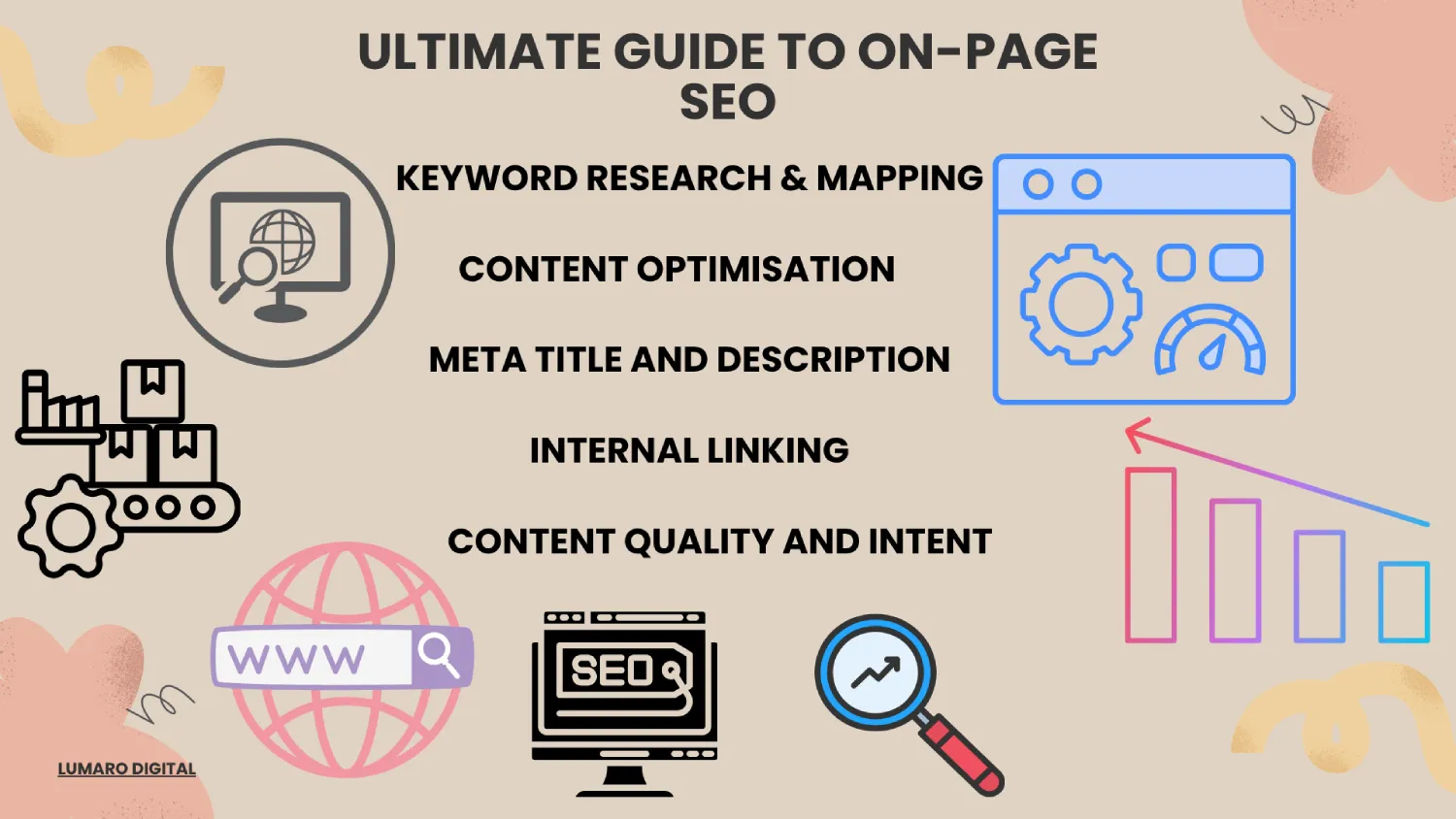
On-page SEO covers a broad range of optimisation activities. Understanding these key elements helps ensure that every aspect of a webpage is optimised to meet both user expectations and search engine requirements, such as:
Keyword Research & Mapping
Keyword research and mapping form the backbone of any effective on-page SEO strategy. Using tools like Ahrefs and Semrush, you can uncover high-value primary and semantic keywords, analyze TF-IDF boosting phrases, and map them strategically across pages to help search engines understand your content.
Content Optimisation
Content optimisation is the process of refining your on-page elements to ensure search engines understand your content while delivering real value to users. By strategically placing target keywords within headings, meta titles, and body copy — supported by TF-IDF boosting phrases and semantic NLP signals — you create high-quality on-page content that aligns with search intent and improves organic rankings.
Meta Title and Description
Meta titles and descriptions are critical on-page SEO elements that directly influence click-through rates and organic search visibility. A well-crafted meta title should include your primary target keyword, remain within 60 characters, and clearly communicate the page's value to both users and search engines like Google.
Internal Linking
Internal linking is a foundational on-page SEO strategy that connects related pages across your site, distributing link equity and helping search engines understand your content structure. Using descriptive, keyword-rich anchor text ensures Google can accurately interpret page relevance, strengthen topical authority, and improve overall organic rankings.
Content Quality and Intent
Content quality and search intent alignment are at the core of any successful on-page SEO strategy. High-quality on-page content must directly answer user queries, match the informational, navigational, or transactional intent behind target keywords, and deliver real value that builds trust and authority with both users and Google.
URL Structure Optimisation
A clean, SEO-friendly URL structure is a fundamental on-page SEO factor that helps search engines and users understand page content instantly. Keeping URLs short, descriptive, and keyword-rich — while avoiding unnecessary parameters, numbers, and complex strings — improves crawlability, strengthens relevance signals, and supports better organic rankings on Google.
Image SEO Optimisation
Image SEO optimisation is an essential on-page factor that improves both search visibility and user experience across your site. Using descriptive, keyword-rich file names and alt text helps search engines understand your visual content, while compressing images for faster loading speeds directly supports core web vitals and mobile SEO performance on Google.
Technical Fixes
Technical fixes are a critical foundation of on-page SEO, ensuring your site is fully crawlable, indexable, and optimised for search engine performance. Addressing core issues such as broken links, duplicate content, slow page speed, and mobile optimisation problems directly strengthens your site's authority signals and improves organic rankings on Google.
The Ultimate On-Page SEO Checklist (Step-by-Step)
Follow these 17 steps in sequence to optimise any page from scratch, or use them as a diagnostic audit framework for existing content.
Step 1: SEO Audit (Baseline Analysis)
Start by auditing rankings, technical issues, and content gaps using free SEO tools.
Step 2: Keyword Research & Intent Analysis
Study keywords, analyse intent, and map each term to the right page.
Step 3: Content Gap & Competitor Research
Analyse top competitors, spot content gaps, and build a more comprehensive resource that outranks them.
Step 4: Title Tag Optimisation
Write keyword-rich titles under 60 characters and test variants for better CTR.
Step 5: Meta Description Optimisation
Write a keyword-rich meta description that compels users to click.
Step 6: Header Tag Optimisation
Use one strong H1 and logical H2/H3s to structure your page clearly.
Step 7: Content Optimisation
Cover your topic fully, construct keywords naturally, and back claims with real data.
Step 8: URL Optimisation
Keep URLs short, clean, and keyword-rich, and redirect any changes with a 301.
Step 9: Internal Linking Strategy
Link to 3–5 related pages with descriptive anchors to spread authority naturally.
Step 10: Image Optimisation
Compress, rename, and add alt text to every image to speed things up.
Step 11: Schema Markup
Add schema markup to earn rich results and stand out in the SERPs.
Step 12: Technical On-Page Fixes
Fix broken links, duplicate tags, and crawl errors before they hurt rankings.
Step 13: Core Web Vitals Optimisation
Improve LCP, CLS, and INP scores so your page feels fast and stable.
Step 14: Crawlability & Indexability
Make sure Google can actually find and index your page without barriers.
Step 15: Mobile Optimisation
Make sure your page looks and loads great on every mobile device.
Step 16: Content Updates & Freshness
Revisit your content every 6–12 months and keep it current.
Step 17: Performance Tracking & Iteration
Track rankings and traffic regularly, then tweak what isn’t working.
Common On-Page SEO Mistakes to Avoid
Even experienced SEOs fall into these traps. Understanding the most common on-page mistakes allows you to identify and fix them before they cost you rankings.
Keyword Stuffing
Keyword stuffing, forcing your target keyword into the page at an unnaturally high density, was a tactic in the early 2000s. Today, it triggers algorithmic penalties and damages readability. Example of what to avoid: ‘Our on-page SEO offers the best on-page SEO, because on-page SEO is what our on-page SEO team does.’ Instead, use your keyword where it reads naturally and rely on semantic variants for the rest.
Duplicate Content Issues
Duplicate content confuses search engines about which version of a page to rank, diluting authority across multiple URLs. Common causes include WWW vs. non-WWW, HTTP vs. HTTPS, trailing slashes, and session ID parameters. Use canonical tags to designate the preferred URL and ensure thin or syndicated content is properly managed.
Poor Internal Linking
Orphan pages (pages with no internal links pointing to them) are effectively invisible to crawlers. Over-reliance on generic anchor text (‘click here’, ‘read more’) wastes the opportunity to signal relevance. Conversely, over-linking from a single page dilutes the PageRank signal passed to each destination. Follow a simple rule: link purposefully, with descriptive anchors, to pages that genuinely add value for the reader.
Ignoring User Search Intent
The most technically perfect page will underperform if it mismatches user intent. An informational query landing on a product page, or a transactional query landing on a blog post, will generate poor engagement signals — high bounce rate, low dwell time — which negatively reinforce rankings. Always verify intent against the SERP before deciding on content type and angle.
Ignoring Mobile Optimisation
Failing mobile-first indexing is a significant risk. Common mobile issues include text that is too small to read, tap targets too close together, content wider than the screen, and excessive interstitials. A quick five-point mobile audit: (1) run Google’s Mobile-Friendly Test, (2) check font sizes in DevTools, (3) test tap targets with the Accessibility panel, (4) test on a real device, (5) measure mobile page speed separately from desktop via PageSpeed Insights.
FAQs
How to do On-Page SEO?
To do on-page SEO, start with specific keyword research and search intent analysis, then optimize a webpage title, meta descriptions, headings, URL slug, internal links, external sources, images, and schema markup. Ensure high-quality on-page content match queries and measure your on-page SEO using analytics and Search Console data.
What are the best On-Page SEO Tools?
The best on-page SEO tools include Semrush, Ahrefs, Surfer SEO, Screaming Frog, and Google Search Console. These tools analyze keywords, detect technical issues, provide optimization recommendations, track rankings, and measure performance metrics to improve search visibility.
Which factor is most important in on-page SEO?
Content quality and search intent alignment represent the most important factors in on-page SEO because high-quality on-page content helps search engines understand your content, match queries accurately, and improve rankings based on relevance and user engagement.
What is the difference between on-page SEO and off-page SEO?
On-page SEO focuses on optimizing content, headings, tags, links, and structured markup within a webpage, while off-page SEO focuses on external factors such as backlinks, media mentions, and digital relations that build authority outside the website.
How often should I update my on-page SEO content?
You should update on-page SEO content every 6–12 months or when rankings decline, traffic drop, or new data appear; regular content updates refine keywords, improve relevance, and maintain stable search engine rankings.